
Lot Size Finder
Your lot size is on your property records, but measurements, plat maps and online maps often give only the side lengths. This finder turns those measurements into area — for rectangular, wedge-shaped, triangular or irregular lots — converts it into square feet, acres, square metres and hectares, and works out lot coverage for a planned building.
- Free to use
- No sign-up
- Runs in your browser
Lot size calculator
Lot Measuring Pack
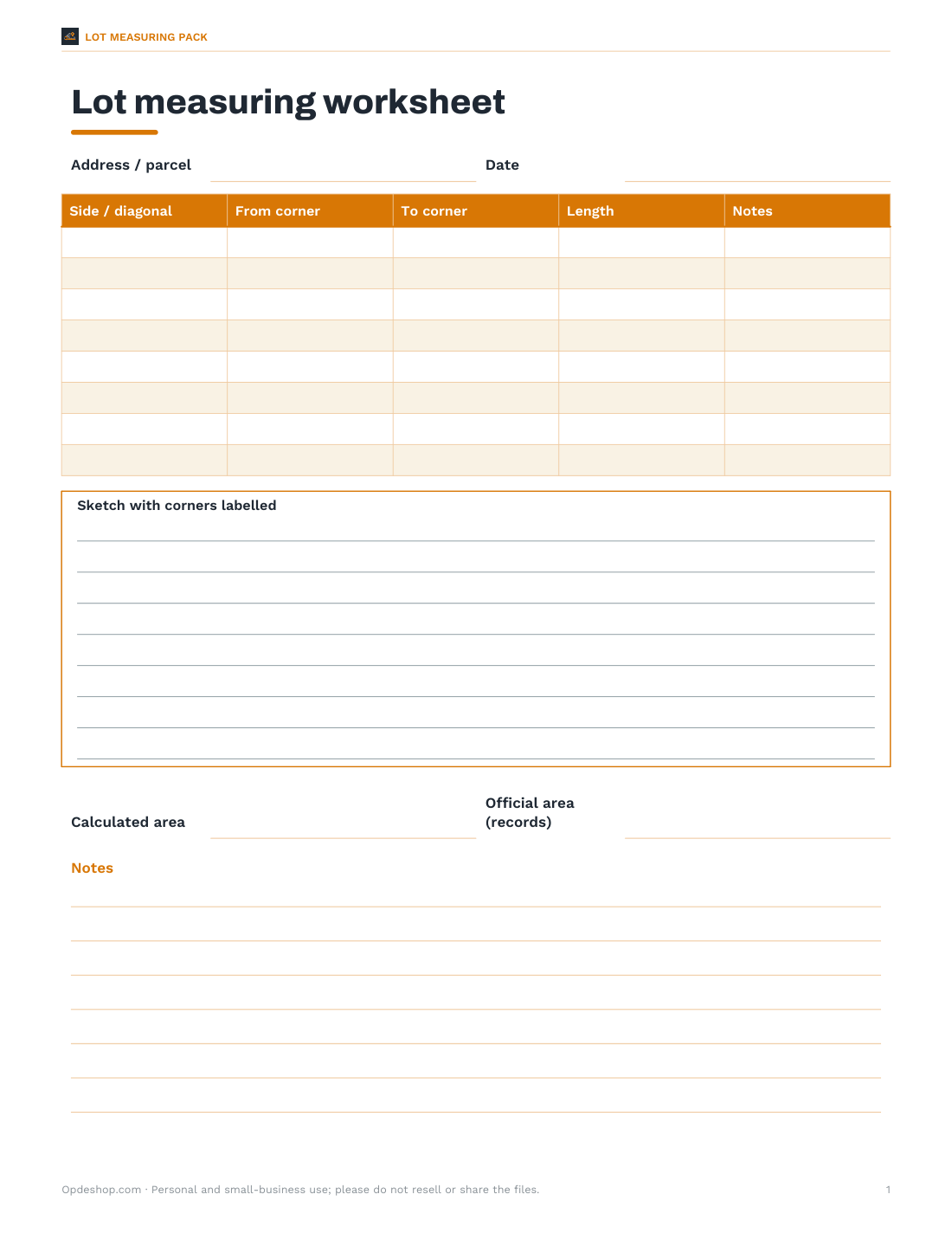
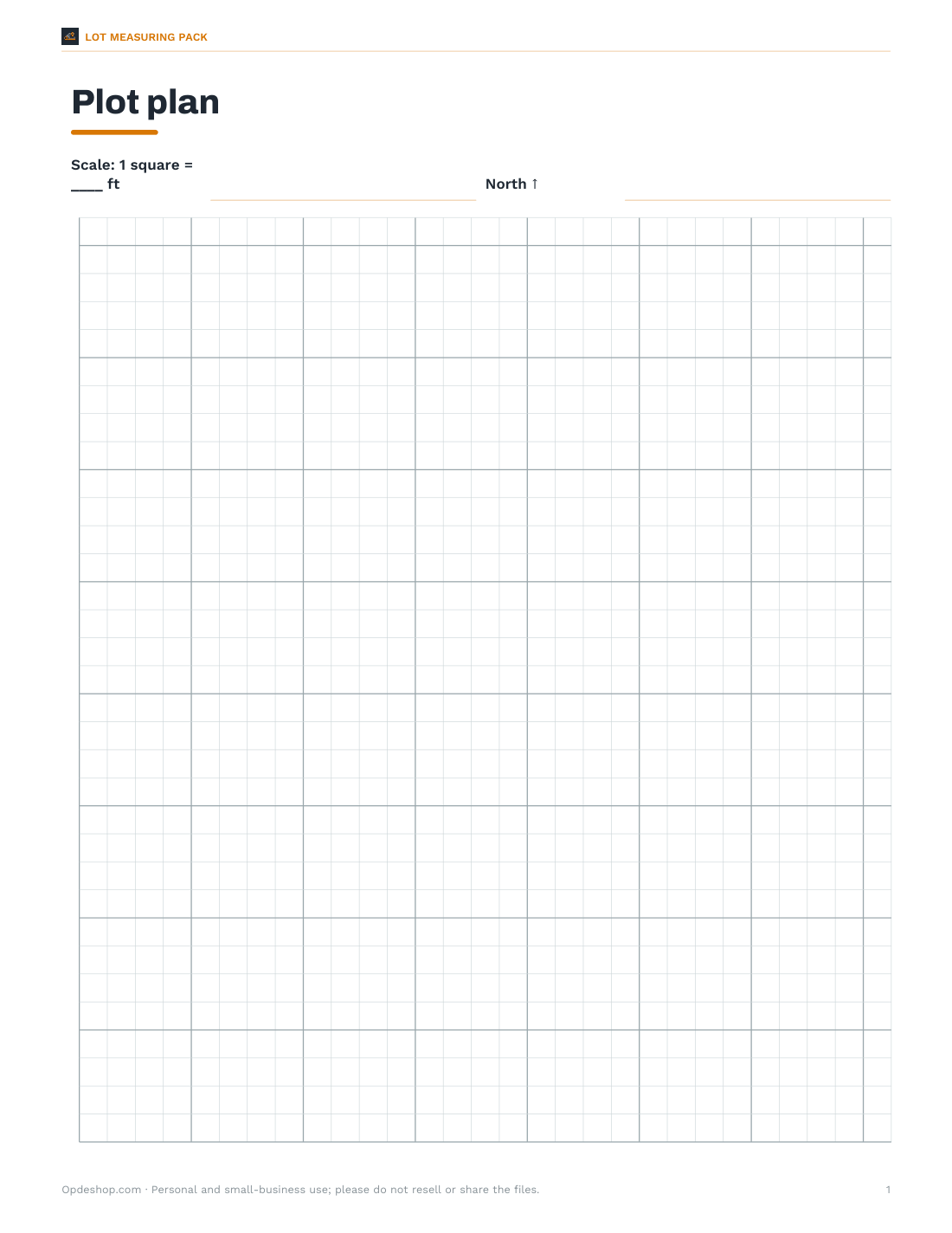
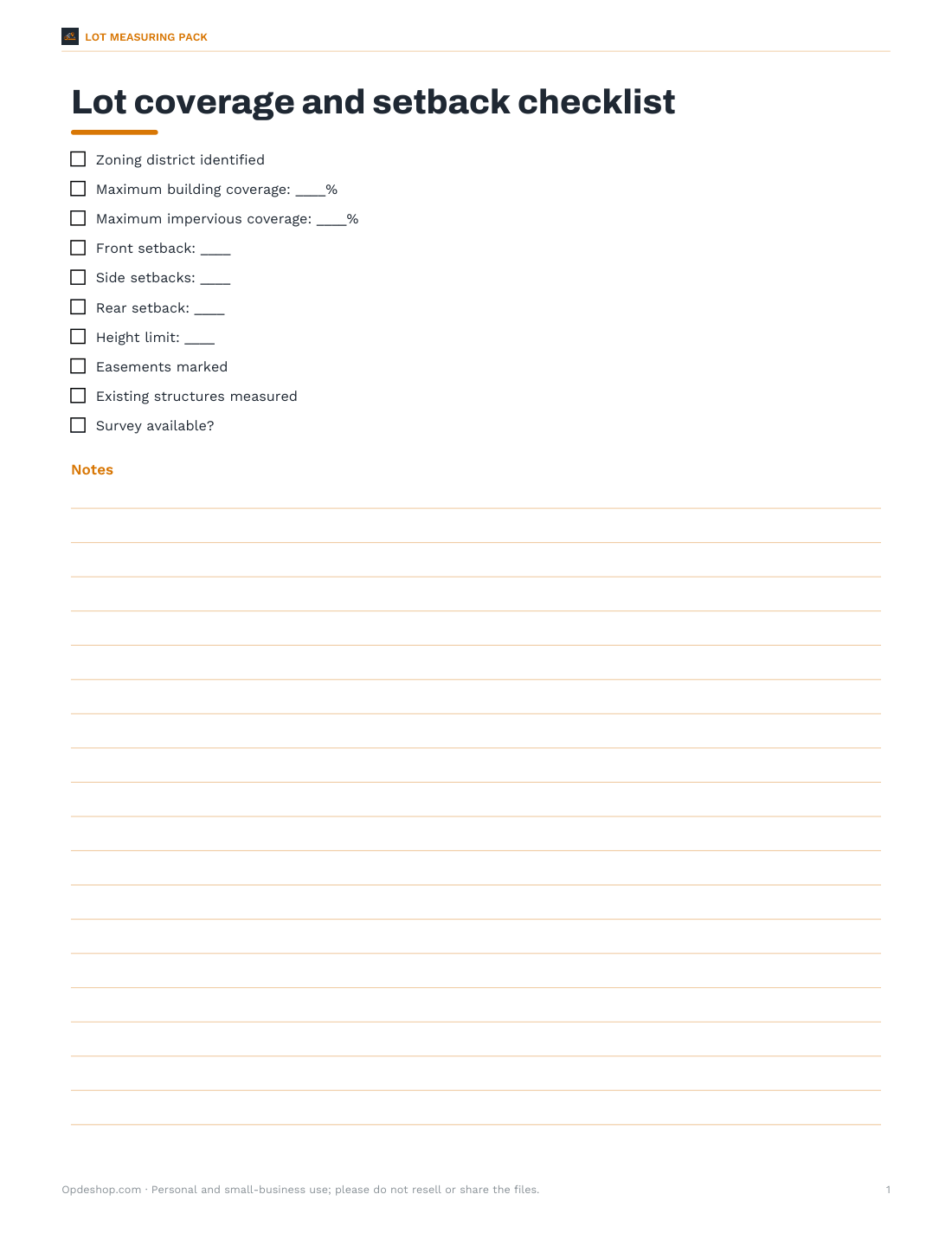
Printable lot measuring worksheet, a plot plan grid, a lot coverage and setback checklist and an area conversion card.
- Measuring worksheet (PDF/DOCX)
- Plot plan grid (PDF)
- Coverage checklist (PDF/DOCX)
- Conversion card (PDF)
Formats: PDF, DOCX. Instant download after payment (link valid 72 hours, up to 5 downloads). AI-assisted: the templates were drafted with AI help and reviewed and laid out before publishing.
$5.00 USD, one-time 4 files · about $1.25 each
- Instant download
- 7-day refund
- Secure checkout by Stripe
7-day money-back guarantee. Full refund within 7 days of purchase, even after you download.
Free sample: Lot Measuring Worksheet (PDF, 47 KB)
Full refund within 7 days — see the refund policy and license.
Free printables
Single sheets you can print right now, no sign-up. The full pack adds every sheet in one download plus the editable files.
 Printable Lot Measuring Worksheet
 Printable Plot Plan Grid
 Printable Lot Coverage Checklist
 Printable Area Conversion Chart
Where to find your official lot size
| Source | What it shows |
|---|---|
| Deed or title documents | Legal description, sometimes the area |
| Property tax record / assessor | Lot area used for tax, often in sq ft or acres |
| Plat map or subdivision plan | Lot dimensions and bearings |
| Land survey | The most accurate boundary measurements |
| County or city GIS map | Parcel outlines and approximate area |
| Listing or appraisal | Area as reported — worth double-checking |
Online maps and GIS parcel lines are approximate; for fences, building permits or disputes, rely on a licensed survey.
Area formulas
| Shape | Formula |
|---|---|
| Rectangle | width × depth |
| Trapezoid | (front + back) ÷ 2 × depth |
| Triangle (three sides) | Heron’s formula: √(s(s−a)(s−b)(s−c)), s = half the perimeter |
| Any quadrilateral | Split along a diagonal into two triangles and add them |
| Any polygon from corners | Shoelace formula on the corner coordinates |
Unit conversions
| Unit | Equals |
|---|---|
| 1 acre | 43,560 sq ft · 4,047 m² · 0.405 ha |
| 1 hectare | 10,000 m² · 2.471 acres · 107,639 sq ft |
| 1 sq ft | 0.0929 m² |
| 1 m² | 10.764 sq ft |
| Quarter acre | 10,890 sq ft |
| Half acre | 21,780 sq ft |
Worked example
A lot 60 feet wide at the street, 80 feet wide at the back and 120 feet deep is a trapezoid: (60 + 80) ÷ 2 × 120 = 8,400 sq ft, or about 0.193 acres (780 m²). A 2,200 sq ft house footprint would cover 2,200 ÷ 8,400 ≈ 26% of the lot — useful when zoning limits maximum lot coverage.
Measuring an irregular lot
- Sketch the lot and label the corners A, B, C, D…
- Measure each side, and at least one diagonal for a four-sided lot.
- For more corners, split the lot into triangles with diagonals, or use corner coordinates.
- Use the calculator’s “any four sides + diagonal” or coordinates mode.
- Compare with the tax record — a big difference suggests a measuring error or an unusual boundary.
Lot coverage and zoning
Many zoning codes limit how much of a lot can be covered by buildings (lot coverage) and sometimes by all hard surfaces (impervious coverage), and set minimum setbacks from boundaries. Typical residential limits range widely — often somewhere between about 30% and 50% building coverage — so check your local code before planning an extension, garage or pool.
Using corner coordinates
If your plat map or survey gives bearings and distances, or you can read corner coordinates from a mapping tool, enter each corner as x,y in order around the lot. The calculator uses the shoelace formula — the standard way surveyors compute the area of any polygon from its vertices. The first and last points connect automatically, and the drawing lets you check the shape looks right.
Easements and usable area
Your lot size is the total area inside the boundaries, but not all of it may be usable. Easements for utilities, drainage or shared driveways, steep slopes, wetlands and setback zones all limit where you can build. When comparing lots, look at the buildable area as well as the total size.
Checking your answer
Compare your result with the lot area on your tax record or listing. Small differences are normal — records may round, or measure to a different line such as the edge of a road. A difference of more than a few percent usually means a measurement or unit mix-up (feet versus metres), a missing corner, or a boundary that is curved rather than straight.
Frontage and depth
Many listings describe lots as frontage × depth — for example 60 × 120 — where frontage is the width along the street. Frontage affects driveway placement, house width and sometimes minimum lot requirements in zoning codes. Corner lots have two street frontages and often two front setbacks, which can reduce the buildable area compared with an interior lot of the same size.
Typical lot sizes
- Urban lots in older cities can be 2,500–5,000 sq ft.
- Suburban lots are often 6,000–12,000 sq ft (roughly ⅛ to ¼ acre).
- Rural and large-lot zoning may require an acre or more.
- A US football field without end zones is about 1.1 acres, which helps visualise an acre.
Property planning pack
The optional pack includes a printable lot measuring worksheet, a plot plan grid, a lot coverage and setback checklist and an area conversion card. The finder above is free.
AI-assisted content
This page was drafted with AI assistance and reviewed before publishing. It is not a survey; use a licensed surveyor for legal boundaries.
Frequently asked questions
How do I find my lot size?
Check your deed, tax assessor record, plat map or survey — or measure and calculate it here.
How many square feet are in an acre?
43,560.
How do I calculate the area of an irregular lot?
Split it into triangles or use corner coordinates with the shoelace formula.
What is lot coverage?
The share of the lot covered by buildings, often limited by zoning.
Are online parcel maps accurate?
They are approximate; a survey is the reliable source.
How many acres is 10,000 sq ft?
About 0.23 acres.
What is the difference between lot size and square footage?
Lot size is the land area; a home’s square footage is its interior floor area.
How big is a quarter-acre lot?
10,890 sq ft — for example about 66 × 165 ft.
Can I use it for metric lots?
Yes, choose metres and the result is shown in m² and hectares as well.
Does it work for a curved boundary?
Approximate the curve with several short straight sides using corner points.